DAPT-MVD Trial
(07/27/2026) Week 216 - Post PCI antiplatelet recommendations (Dual vs Single)

Tian J, Wang Z, Wang Y, Wang F, Peng X, Xiao J, Li C, Hou X, Tong Q, Yu X, Gao G, Zhao P, Zhao J, Liu Y, Qin Z, Lu H, Zhang S, Li S, Weng Z, Tang H, He Y, Zhang C, Liu Yong, Jiang J, Zhang J, Cai L, Xiu L, Mintz GS, Wang D, Stone GW, Yu B; DAPT-MVD Trial Investigators. Extended dual antiplatelet therapy for multivessel coronary artery disease. N Engl J Med. 2026;395(3):233-242. doi:10.1056/NEJMoa2517588
Patients with low risk of bleeding who have multivessel CAD are recommended to have one year of dual antiplatelet therapy for 12 months, but what about beyond?
Per the 2023 ACC Guidelines for the management of chronic coronary syndrome–

The classic 2b recommendation followed by A recommendation. Or in other words a conditional recommendation, but we are sure of it? Someone smarter than me–make it make sense.
Anyway.
Here is a “helpful” chart which outlines the recommendations.
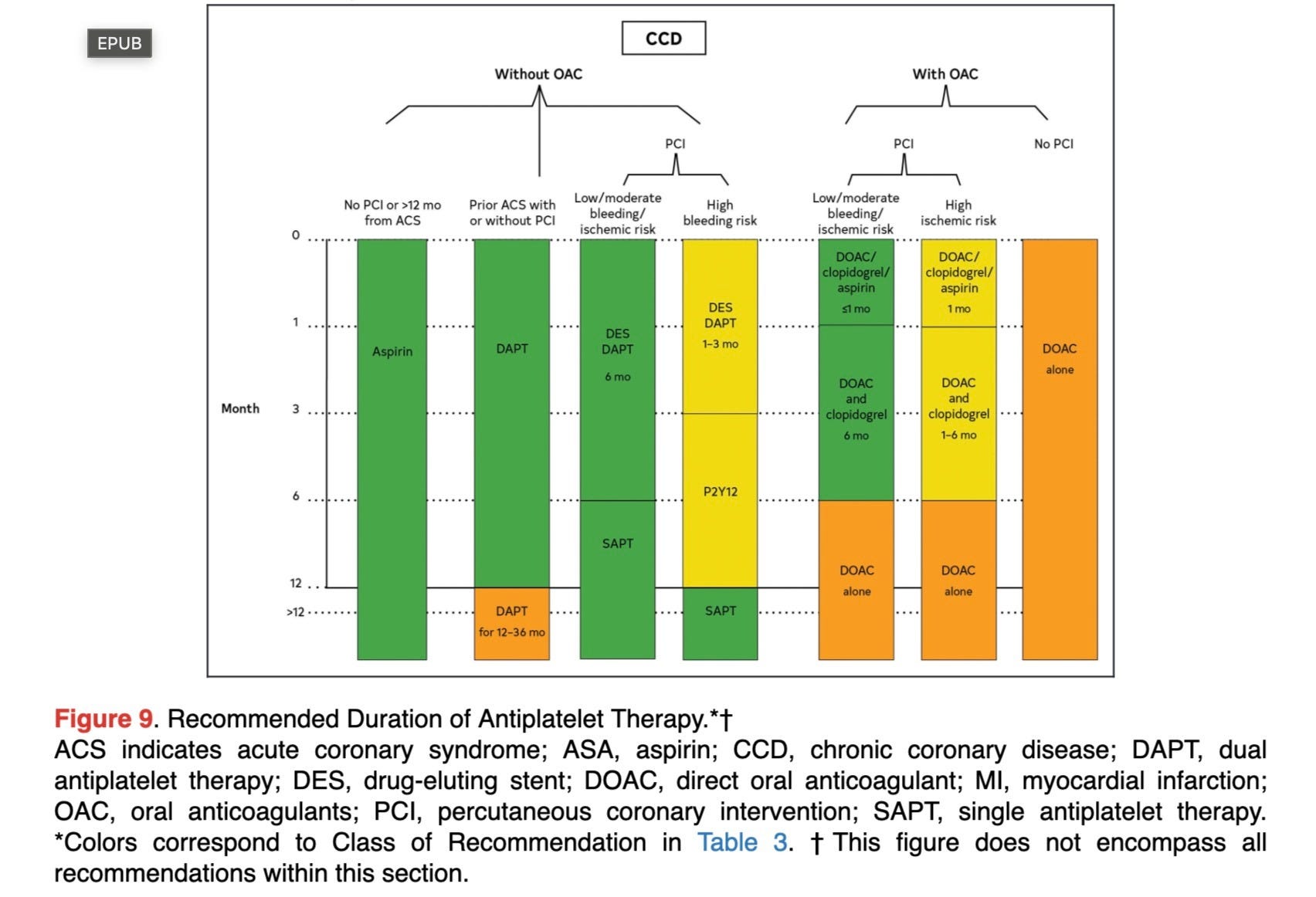
The orange box in the bottom left is the post 12 month recommendation of DAPT in previous disease. DAPT-MVD aims to make that orange box turn green.
Design
The DAPT-MVD trial Open Label, Intention to Treat, randomized controlled trial. Eligible patients were adults with multi-vessel CAD (defined as two or more coronary arteries with >50% or more stenosis) who had implantation of drug-eluting stent(s) and who had been stable for 12 months on DAPT. Patients who were on anticoagulation (DOAC) or contraindications for antiplatelet therapy were excluded from the start.
12 months after PCI, patients were randomized 1:1 to receive clopidogrel plus asa (DAPT group) or asa alone (monotherapy group) for an additional 12 months.
Primary efficacy outcome was composite of death from CV causes, nonfatal MI or nonfatal stroke. Primary safety endpoint was clinical relevant or major bleeding. They assumed an annual efficacy outcome rate of 5% per year.
Results
8250 patients were randomized. The mean age was 61, 30% were female, 28% had diabetes. 80% had a single stent, with 20% having multiple stents placed during index stenting. 45% had two vessel disease with 55% having three vessel disease.
Median follow-up was 34 months.
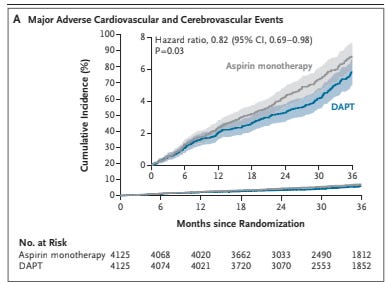
Primary endpoint occurred in 5.8% vs 6.8% (CI 0.69-0.98). This statistically significant effect was driven by the nonfatal MI portion of the composite. All-cause death and CV death were not significant. Clinical bleeding (safety endpoint) was not statistically different in either group (1.4% vs 1.5%).
External Validity - Do I see these patients?
Yes! (Kinda). I see patients with multivessel CAD with prior history of stenting a few times per week. However, RUI patients in general tend to be older with high risk of CAD and bleeding.
Risk of Bias?
The open label bothers me, but theoretically that would not affect the outcomes given the blinded assessors. I also find the lack of difference in bleeding odd, but perhaps another remind the low risk of bleeding to begin with. Always a good reminder that trials are powered for efficacy, not safety outcomes.
What were the benefits?
The primary outcome was significant, but a closer look at the specific components and you see it was driven by non-fatal MI. NOT CV death. This is not necessarily a bad thing, but does make me less excited. It is also a relatively small benefit. (NNT 100)
What were the harms?
The safety outcome (bleeding) was no different in either arm but there are important caveats. This East Asian cohort tends to have CYP2C19 loss-of-function alleles which reduce clopidogrel bioactivation. This could reduce the risk of bleeding (but also reduce the efficacy of clopidogrel). There is always the risk of adding another pill that just gets perpetuated on a med list indefinitely when follow-up care is fractured in vulnerable populations.
So what?
The most important takeaway is that the patients who benefited already tolerated DAPT for 12 months before they could even get into the study. So for patients who have any issues taking anti-platelet (bleeding or otherwise), this study does not apply to them. In addition there is the nebulous hypothesis that clopidogrel has a different effect in populations with different genetics. In addition, what about clopidogrel alone?
I would be nervous about extending DAPT given this modest reduction in non-fatal outcomes, but for patients who are maximizers, in which pill burden is a non-issue, and low risk for bleeding, extending DAPT is reasonable.