The forgotten stepchild–Amiloride. (SPARE Trial)
(06/29/2026) Week 212

I have never prescribed Amiloride.
This blindspot is related to my training, and my own doing. It wasn’t till after reading the BaxHTN trial and now seeing commercials for baxdrostat (aldosterone synthetase inhibitor) did I couldn’t ignore it anymore. The BaxHTN trial compared baxdrostat against placebo in resistant HTN. Conveniently it did not compare Baxdrostat to spironolactone, but did advertise the lack of hormone related side effects (gynecomastia) compared to spironolactone.
But what about amiloride? It has a similar mechanism of action as spironolactone. And all of these drugs affect the same pathway. And most importantly these drugs cannot be used together.
Enter the above study published in 2025.
The SPARE trial took adult patients with resistant hypertension and randomized them to receive open label spironolactone 12.5 mg vs amiloride 5 mg. Resistant hypertension was defined as patients who were on triple therapy (RAAS, CC blockers and thiazide diuretics with a systolic BP >130.
There was a run-period before randomization where all patients were put on a fixed dose drug regimen of amlodipine, olmesartan and hctz. The doses were at investigator discretion. At the end of 4 weeks run-in, patients with BP >130 were consented and randomized.
Patients were instructed to check BP twice per day, morning and evening.
BP was monitored at home and office visits. During the titration period, the study drugs were increased if SBP was >130 and K was less than 5.0.
The BP during visits of all the home and office visits were used for analysis. A mean home BP of 130/80 or greater was defined as uncontrolled home BP. Participants with at least 8 measurements were included in the analysis.
The primary endpoint was the difference of home SBP between spironolactone and amiloride from baseline to week 12.
The null hypothesis was that amiloride would be inferior to spironolactone by more than the inferiority margin–set at 4.4 mm Hg.
Between 2020 and 2024, 118 participants met inclusion and were randomized. 114 were included in the full ITT analysis and 94 were included in the per protocol.
At week 12, mean home SBP decreased by 14 mm Hg in the amiloride and 15 mm Hg in the spironolactone group. Amiloride met the pre-specified criteria for noninferiority. Per protocol analysis showed similar results.
No participants developed gynecomastia. Stopping the drug because of hyperkalemia occurred less than 1% of the time (none in the spiro group), but of note, hyperkalemia over 5.0 at 12 weeks in 15% of the amiloride group vs 7% in the spiro group.
So what is the takeaway?
Amiloride appears to be a very reasonable option to improve BP at least in patients with resistant HTN. It also theoretically avoids the side effects of gynecomastia or mastalgia.
So what is the impact of the SPARE trial? Below is a sample of the advertising for the 1000 dollar baxdrostat as the campaign rolls out this year. My instagram is filled with such advertisements.
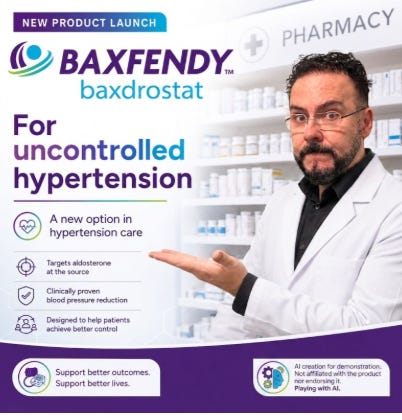
There are no advertisements for the generic 5 dollar amiloride.
The worst part is that amiloride had to prove itself against spironolactone. Baxdrostat was compared against placebo.
You might say, but but they are use mechanisms!
Surely when ARBs were first developed we also compared them to placebo and not ACEs, right?
Why does the more expensive baxdrostat get an easier bar to clear when ARBs had to prove their metal against the older ACEs?
I am genuinely asking.
In my experience, there is always more to the story. I just don’t see it for this one.
The usual story.